

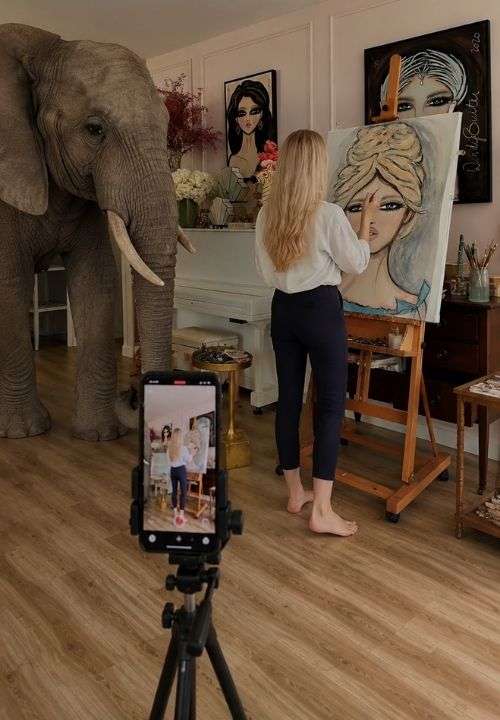
There’s a question I’ve been wanting to ask for quite some time. Not because I have the answer. But because I suspect many artists are thinking the same thing. Can you still be taken seriously as an artist if you also build a personal brand? I began my career as a full-time artist in 2014. Before that, I had spent years in a completely different world. I worked as a professional makeup artist and later became the owner and director of a staffing agency and academy within the cosmetics industry. Creativity had always been part of my life, but in 2014 I made the decision to devote myself entirely to becoming an artist. Around that same time, Instagram was rapidly changing the way artists shared their work.
At first, I simply used it as a portfolio. I posted paintings to see how people responded. Which pieces resonated? Which colours, compositions or subjects sparked conversations? The likes weren’t just flattering. They gave me confidence. They became a form of feedback during a period in which I was still discovering my artistic voice. Then something interesting happened. Whenever I appeared in a photograph with one of my paintings, engagement increased. When I shared a glimpse of my studio, people stayed longer. When I talked about the story behind a painting, collectors connected more deeply with the work. It slowly became clear that people weren’t only interested in buying art. They wanted to know the person who created it.
Today that seems perfectly normal. But within the traditional art world, it still feels like something we’re not really supposed to talk about. There has always been an expectation that the artist should remain somewhat mysterious. That the work should speak entirely for itself. Personal branding, sharing your daily life or posting about the things that inspire you can sometimes feel almost inappropriate, as though it somehow diminishes the seriousness of your practice. I’ve often wondered where that expectation comes from. My own path certainly hasn’t been conventional.
I attended the Gerrit Rietveld Academie for an orientation year, but I didn’t follow the traditional academy route afterwards. Instead, I spent years learning in different ways: fashion illustration, life drawing, sketching, studying anatomy, experimenting with materials and, perhaps most importantly, developing an obsession with refining my own visual language. Everything I know has been built layer upon layer, driven by curiosity.
Does that make me less of an artist? I don’t think so.
Yet I sometimes wonder whether the more established parts of the art world see it differently. If you share your favourite earrings because you genuinely love beautiful craftsmanship… If you post about the dress you chose for an exhibition opening… If you write honestly about raising a son with a severe disability… If you show your audience the museums you visit, the hotels that inspire you or the interiors that influence your compositions… Have you somehow become less serious? Or have you simply allowed people to understand where your work comes from?
Personally, I don’t believe collectors only buy a painting. They buy the years behind it. The experiences. The influences. The obsessions. The values. The artist. Perhaps social media has simply made that process visible. For centuries, collectors only saw the finished masterpiece hanging on a gallery wall. Today, they can watch an artistic practice unfold in real time. They witness the doubts, the experiments, the failures, the breakthroughs and the evolution of an artist over many years. That has never happened before in the history of art. Maybe that’s what makes this moment so fascinating.
We’re the first generation of artists building careers while the entire creative process is being documented, discussed and shared with the very audience that supports it. I sometimes wonder how this period will be viewed fifty years from now. Will historians see social media as something that diluted artistic practice? Or will they see it as the beginning of a new relationship between artists and their audience? Perhaps they’ll admire the artists who not only developed a recognisable body of work, but also had the courage to build an audience, tell their story and create an independent career in a rapidly changing world. I honestly don’t know. But I do know one thing.
The elephant in the room isn’t social media. The elephant in the room is that we’re still pretending artists aren’t expected to be entrepreneurs, storytellers, marketers and public figures, all at the same time. Perhaps it’s time we started talking about that.
Love,
Wendy

Leave A Comment
You must be logged in to post a comment.