

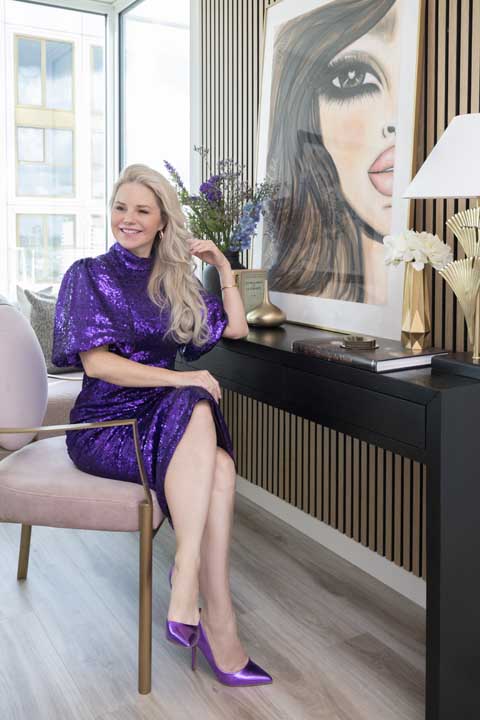
For a long time, art was often spoken about as decoration. Something beautiful for above the sofa. Something that “matches the interior.” Something to fill an empty wall. But after years of creating and selling art, I no longer believe that is the real reason people buy it. At least not the people I meet.
What I have experienced over and over again is that people are actually searching for something much deeper. They are searching for connection. Identity. Atmosphere. Emotion. A reflection of themselves and the life they want to create around themselves. When someone falls in love with a painting, it is rarely just because of color composition or style alone. It is because the artwork represents something.
A feeling. A memory. A version of themselves. A certain femininity. A certain softness. A certain ambition. A certain way of living. And once the artwork enters their home, it becomes part of their emotional world.
I often hear collectors talk about how they look at a painting every single day. How it changes the atmosphere of a room. How it reminds them of something important to them. Sometimes they even tell me the artwork motivates them, comforts them or reflects the kind of energy they want in their lives. That is not decoration. That is emotional meaning. And I think this shift says something much larger about contemporary culture.
Because increasingly, people are using aesthetics to express identity. Not only through fashion, but through interiors, objects, books, art and the worlds they build around themselves. In many ways, our homes have become emotional self portraits. The artwork someone chooses says something about:
- what moves them emotionally
- what kind of life they value
- how they see themselves
- how they want to feel
- what they aspire toward
And yes, sometimes even status plays a role. But I do not necessarily think that is superficial. Throughout history, art has always communicated status, culture and identity. From aristocratic portraiture to collector culture, art has long functioned as a symbol of taste, education and belonging. The difference today is that the emotional aspect has become much more personal. People are no longer only buying art to impress others. They are also buying it to emotionally reinforce something within themselves.
A beautiful artwork can become a daily reminder of:
- elegance
- ambition
- femininity
- sensitivity
- freedom
- refinement
- emotional depth
In that sense, art becomes psychological architecture. Interestingly, science increasingly supports the idea that art and aesthetics affect us far more deeply than we often realize. Research within the field of neuroaesthetics has shown that viewing art activates brain regions connected to reward, emotion and self reflection.
In 2024, neurological research conducted in collaboration with the Mauritshuis Museum in The Hague even found that original artworks created significantly stronger emotional and neurological responses than reproductions, particularly in brain regions associated with personal meaning and memory.
There is also growing research around “neuroaesthetics,” a field exploring how the brain responds to beauty, art and visual harmony. Studies using brain imaging have demonstrated that viewing art can activate reward systems in the brain associated with pleasure, meaning and emotional processing. In other words: beauty is not simply visual. It is neurological and emotional. Perhaps that is why people care so deeply about the spaces they live in. Not because they are shallow. But because humans naturally seek environments that emotionally support who they are and who they hope to become.
As an artist, this fascinates me endlessly. Because when I create a painting, I am not only creating an image. I am creating an atmosphere. A symbolic world. A certain emotional language. And the people who connect with my work are usually not responding only to the painting itself, but to what it represents psychologically.
Femininity. Strength. Elegance. Softness. Beauty. Emotional intensity. Cultural aspiration. What I have learned over the years is that people do not simply collect objects. They collect reflections of their inner world. That is why art matters. And perhaps that is why it will always matter.
Love,
Wendy





Leave A Comment
You must be logged in to post a comment.