

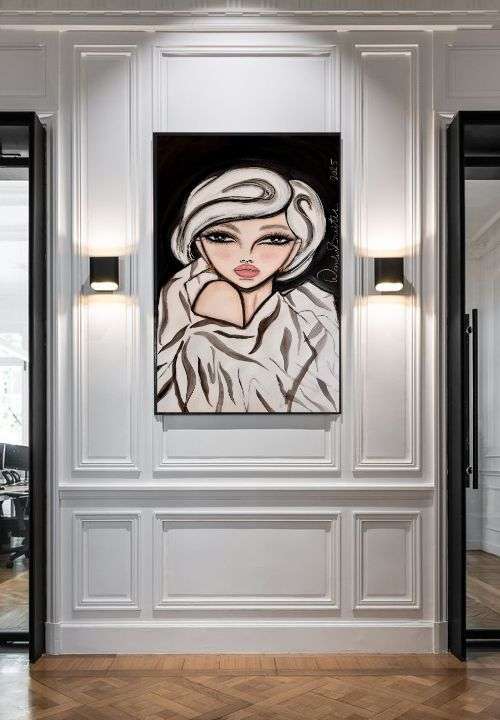
In recent years, the term “female gaze” has become increasingly visible across museums, galleries, and cultural platforms. It’s often mentioned in press releases and exhibition texts, but what does it actually mean? And why does it resonate so deeply with contemporary art? For me, this theme has always been present in my work, even before I ever named it. My muses stand in the center of the image. They look back. They claim space. Their beauty is not ornamental, it is declarative. This is where the female gaze begins.
What the Female Gaze really means
The term female gaze emerged as a response to the male gaze, a concept introduced by film theorist Laura Mulvey in 1975. Mulvey described how, historically, women in visual culture have often been positioned as objects of desire, framed through a male perspective. The female gaze reverses that power dynamic. It asks:
What happens when women are not merely looked at, but become the subjects of their own image?
What happens when they are the ones who look back, or even define how they appear in the first place?
This shift from object to subject is the red thread of the female gaze. It’s about power, visibility, and ownership of the image.
Three core ideas behind the Female Gaze
While the theme can take many forms, the female gaze often revolves around three interconnected concepts:
-
Subjectivity; Women are no longer passive subjects; they are the central point of view.
In visual art, this often translates to figures who confront the viewer, hold their gaze, or simply exist without seeking approval.
-
Agency; The woman decides how she appears, what she wears, how she stands, how she is represented.
Ornament, clothing, body language, and beauty become instruments of self-definition.
-
Representation; A broader and more complex depiction of women’s experiences.
Not idealized muses or decorative figures, but layered, sovereign, multifaceted individuals. In essence: the female gaze is not about who looks at the image, but who owns the gaze.
How artists explore this today
Contemporary artists around the world engage with this discourse in different ways:
-
Lynette Yiadom-Boakye portrays fictional Black figures who carry their own presence, neither apologizing nor explaining themselves.
-
Jenny Saville paints female bodies with monumental strength rather than aesthetic submission.
-
Mickalene Thomas uses ornament, glitter, and glamour as statements of pride and power.
-
Kelly Beeman creates elegant muses that do not seduce but command attention.
These artists do not simply depict women, they reclaim the image itself.
Why this theme matters in the Art World
Museums, curators, and galleries are increasingly drawn to the female gaze because it:
-
Challenges the historically male-dominated visual canon
-
Expands the narrative of who gets to be represented, and how
-
Reflects the cultural urgency of identity, power, and gender politics today
-
Creates new visual languages around femininity, beyond stereotypes
Major exhibitions around this theme have taken place at institutions like the Pennsylvania Academy of the Fine Arts (“The Female Gaze: Women Artists Making Their World”), The Untitled Space (“In the Raw: The Female Gaze on the Nude”), and numerous contemporary galleries worldwide.
The female gaze is no longer a niche conversation, it’s at the center of how contemporary portraiture and figurative painting are being redefined.
My Muses, My Gaze
In my own work, this theme is not an afterthought, it is the foundation. My muses are not objects of someone else’s fantasy. They are subjects in their own right: elegant, poised, powerful. They meet the viewer’s gaze head-on. Their jewelry, headpieces, and ornamental details are not embellishments, but symbols of power and protection. I often describe their presence as “image as armor.”
Beauty not as submission, but as sovereignty. Elegance as a declaration.
In a cultural moment where women’s bodies and identities are constantly mediated, my paintings offer a quiet rebellion: a return of the gaze.
A language that curators recognize
When curators look for new artists, they often search through thematic lenses: female gaze, identity, ornament, mythology, representation. By articulating your work through these frameworks, you don’t just show what you make, you enter the cultural conversation.
Phrases like:
-
“She does not offer her beauty, she claims it.”
-
“Ornament as armor.”
-
“The gaze is not received, it is returned.”
…are the kind of language that speaks to curators, writers, and institutions. It’s a way of saying: this work belongs to a larger narrative. For many years, I painted my muses intuitively. Only later did I realize they were part of something bigger, a living dialogue within contemporary art. Naming it doesn’t make the work less personal. It makes it legible to the world that shapes the canon. The female gaze is not a trend. It’s a reclaiming. A re-centering.
A reminder that the subject of the image can also be its author.
Closing Words
As artists, we don’t just create images, we shape narratives. The female gaze is one of the most powerful narratives of our time, because it gives women agency over how they are seen. And that is exactly what my muses do: they don’t wait to be admired. They look back.
With love,
Wendy Buiter
(part of my ongoing artistic exploration of female autonomy, ornament, and power in contemporary portraiture.)



Leave A Comment
You must be logged in to post a comment.