

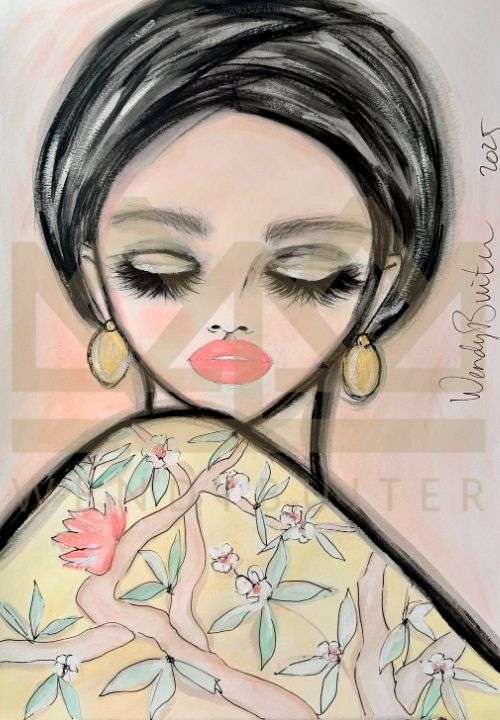
In recent years, much of the critical and curatorial discourse around women in contemporary art has focused on how female artists reclaim the language of femininity. These texts often describe how artists revisit, reinterpret, and subvert the soft aesthetics that were historically used to confine them: pink, florals, gold jewelry, elegance, softness, pleasure, beauty. These artists have done something incredibly important: they have dismantled stereotypes by owning the imagery that once objectified them. Instead of being defined by it, they now define it for themselves. It’s powerful. It’s necessary. And it has shifted the visual landscape of what femininity can mean in contemporary art.
But my work doesn’t stop there.
I overlap with this movement, yes, but I also go further. Where many artists are reclaiming the visual language, I want to rewrite the grammar of power itself.
From language to architecture
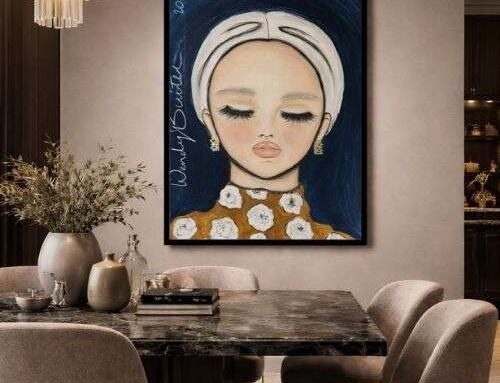
Femininity, for me, is not just a subject or aesthetic. It is a structural force, a language capable of building worlds. While others work within the realm of representation, my practice is aimed at constructing a blueprint for a post-patriarchal order. Not a gesture. Not a critique. A blueprint. I’m not just painting powerful women. I’m painting a future in which female power is foundational, not exceptional. I want to make the presence of women in power not only visible, but inevitable.
Reclaiming the gaze was step one. Reclaiming power is step two.
The “female gaze” is a crucial shift in art history, it takes back agency, it reclaims desire, and it allows women to look rather than be looked at. But a gaze alone doesn’t build new systems. The next step is to place women at the center of those systems,not as muses, not as subjects, but as the architects, the decision-makers, the source code of a new cultural order. Where many artists critique or reimagine, I want to build. I am interested in the infrastructure of power: what it looks like, how it is visualized, who stands at its center, and how that image shapes the world around us.
Feminine power as the foundation, not the exception
I am not interested in presenting femininity as “an alternative” or “a balance.” I am interested in making female power the foundation, the new default. For too long, masculinity has been the silent grammar of power: it has shaped what we see, who we believe, and who leads. My work aims to interrupt that grammar and replace it with a new one, one that is elegant, visionary, unapologetically feminine, and structurally female-led. This is not about simply adding women to the existing frame. This is about reframing the frame itself.
Visionary, political, and intentional
My work has a clear and consistent vision:
– Political, because it confronts centuries of male-dominated visual power.
– Visually strong, because it uses beauty as a strategic language, not an accessory.
– Visionary, because it is not just commenting on the world; it is proposing a new one.
I am not interested in being a footnote in feminist art history. I am interested in changing its trajectory.
I don’t wait for the world I want. I build her.
Feminist art matters. Not just because it challenges stereotypes, but because it can shape the architecture of power itself. And in my vision, female power is not the guest at the table. She is the table.
She writes the language. She owns the gaze. She leads.
“I do not wait for that world. I build her. Image by image, painting by painting.”
So… am I advocating for a matriarchy?
Not exactly. I’m not simply asking to replace one hierarchy with another. What I’m talking about isn’t a mirror image of patriarchy, it’s something more visionary than that. I believe in a post-patriarchal order, where power is not defined by masculine defaults. And yes, I do believe women should hold the vast majority of power, because the balance has been historically and structurally tilted for too long. But my vision isn’t about revenge or inversion. It’s about rewriting the grammar of power itself, shifting it from dominance and extraction to vision, strategy, and cultural leadership rooted in feminine strength. I want women at the center not because men should disappear, but because for centuries, women have been pushed to the margins. A post-patriarchal world recenters that narrative.
And honestly? I think it’s not only fair, it’s overdue.
With love,
Wendy

Leave A Comment
You must be logged in to post a comment.